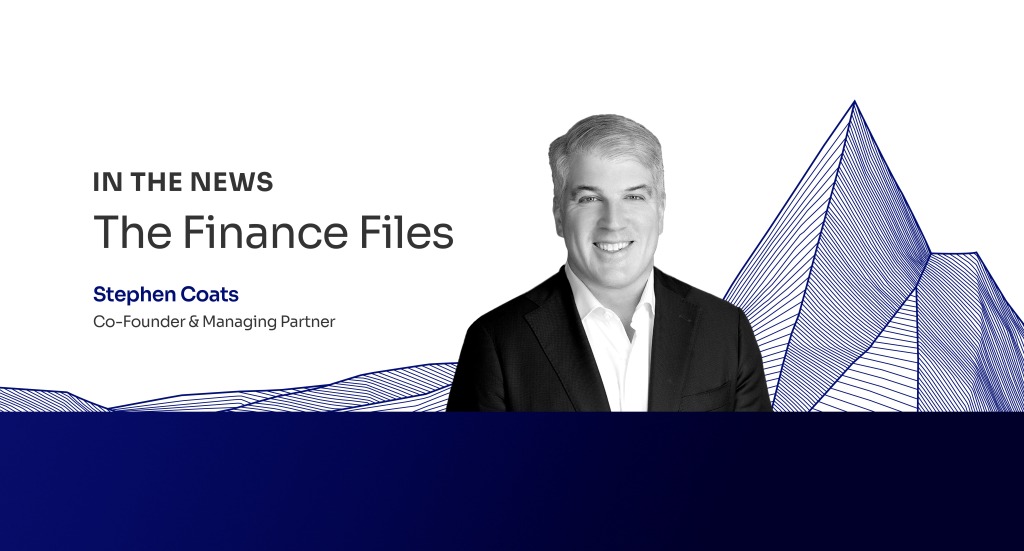
In the April 2 edition of The Finace Files newsletter, Finance Editor Richard Chang spoke with Petra Funds Group’s Co-Founder and Managing Partner Stephen Coats about the evolving fund administration landscape. Read the Q&A below or access it here.
Chang: Can you start by highlighting the services that Petra Funds provides and what role it fulfills in private markets?
Coats: Maybe it’s helpful for me to take a little bit of a step back. I came out of private equity, my co-founder came out of private equity. We had a bit of a firsthand view of what it took to run the infrastructure of a private equity fund and a private credit fund at Riverstone. Every private equity fund and every asset manager is, in some ways, dysfunctional. We have an industry that’s just now starting to institutionalize. Take out Blackstone and KKR – I’m talking about the other 8,000 funds out there that are just not institutionalized today. They sort of go out and invest in things and then they’re like, “Oh my God, we have to report it, so let’s hire a CFO. And they want ESG, so let’s hire a sustainability officer.” It’s this very haphazard way of building up the back office. And historically, there wasn’t software, there wasn’t consulting; none of the sort of couture moments of corporate America existed for the private asset management industry because it just wasn’t big enough.
I remember when I first started in private equity, I would ask the question, “Why are we doing carry calculations on Excel? Isn’t there a software that we can buy for this?” But who builds software for 3,000 firms? There weren’t enough customers for it; now that’s all changing today. And so what we saw at Riverstone was we’re like the precipice of the institutionalization of alternatives, where alternatives are no longer alternative. They’re around 50% of the market. I mean, if you look at private credit, it’s half the market in private loans today. So what we saw was the need for a truly high-touch back-office infrastructure for private asset management, and there didn’t exist a vendor in the market that could provide that, which is surprising to us because normally when you see a demand in the market, you see a million competitors that are there to serve it. We didn’t see that.
Fund administration, at its core, is producing the financial statements for limited partners, as well as quarterly statements for LPs, capital calls, and distributions. It’s management of the portal for LPs, it’s dealing with auditors and tax advisors at the end of the year. There’s a hundred ancillary functions that can come out of that, especially when you talk about credit; there’s middle-office functions, there’s covenant monitoring, there’s loan monitoring, there’s administration. Traditionally, firms were hiring cheap accountants in India, and they were doing kind of a 60% job on producing financials. That was the model. What we didn’t see was someone who could come with a very experienced model and say, “We’re going to effectively be your back office.”
Chang: Have you seen this change in the last couple years? Is there more focus on these types of services, or is there more competition out there now?
Coats: Yes, there’s more focus and no, there’s no more competition. Lucky for us, this is a service that is somewhat industry- and cyclically protected. If fundraising is going really well, then people are raising new vehicles and there’s lots of new work. If fundraising’s not going really well, then people are super-focused on the bottom line of the management company. A lot of what we do is paid for by the fund and not by the management company. So you’re trying to really be efficient to the management company if you’re not raising new vehicles.
There is an older generation of private equity, including Goldman Sachs partners who left and started private equity funds after it went public. What’s happening today is many of those funds are so tied to the personality of the founder that they will forever be with that founder, and they will probably cease to exist at some point because that founder will never let go of the reins. And in that case, a lot of those younger partners are going to leave and start their own funds. So they need fund administration services because every new fund uses a fund admin. If they’re not inextricably tied to the personality of the founder, they’re handing the reins over to the younger partners, the 45-year-old people who are now turning back toward the company and saying, “Wait a second, why did we run this? It’s a little disorganized. We are doing it ourselves.” They’re sort of reorganizing, and they’re instituting new practices. There is a renewed focus on outsourcing and co-sourcing that there hasn’t been historically.
Interestingly, there isn’t renewed competition. In order to have good competition in this market, you have to have people who have good experience inside private equity funds and private credit funds. Largely, that’s CFOs. How many CFOs or Blackstone employees are going to leave those places to start a service company? They’re just not. You have to be willing to leave a carried interest pool of many millions of dollars to start a service company that may or may not work.
Chang: What other trends and developments in this field are you most excited about at the moment?
Coats: In the last 12 months, co-sourcing is a huge trend – basically a form of outsourcing where someone is working within your system. So firms that historically had not outsourced are asking you to come into their general ledger system rather than them coming onto yours. So that’s a relatively new but important trend. I think that there being more retail-like vehicles is a huge trend today. People are trying to work through what that’s going to look like for not just the big funds, but the middle-market funds going forward. And then there’s everything in the credit space. Credit grew so quickly in the last five years that you have a relatively disorganized back-office infrastructure today with billions and billions of dollars. JPMorgan and Citibank had hundreds of thousands of people sitting in India doing this work, and suddenly 50% is being done by private funds in the U.S. and they have 10 people sitting in Michigan. That doesn’t work. The work’s just not getting done today. So it needs to be organized at a time when private credit is growing so quickly.